Every year, thousands of organizations lose enterprise deals—not because their product isn’t good enough, but because they cannot demonstrate that they protect customer data.
Today, security questionnaires, vendor risk assessments, and compliance requirements have become a standard part of doing business. For SaaS companies, managed service providers, fintech companies, healthcare organizations, and technology vendors, SOC 2 compliance is often no longer optional—it’s an expectation.
This guide explains everything you need to know about SOC 2 compliance, including how it works, the audit process, timelines, costs, and how modern compliance platforms simplify the journey.
What is SOC 2?
SOC 2 (System and Organization Controls 2) is an independent attestation framework developed by the American Institute of Certified Public Accountants (AICPA).
Rather than certifying a product, SOC 2 evaluates whether an organization’s security controls are designed and operating effectively to protect customer data.
A licensed CPA firm performs the examination and issues a SOC 2 report based on the selected Trust Services Criteria.
The Five Trust Services Criteria
Organizations may choose one or more of the following criteria:
Security
Protect systems against unauthorized access.
Availability
Ensure systems remain available and operational.
Processing Integrity
Process information accurately and completely.
Confidentiality
Protect confidential information from unauthorized disclosure.
Privacy
Manage personal information responsibly and in accordance with commitments.
Most organizations begin with Security and later expand into additional criteria.
SOC 2 Type I vs Type II
Many organizations ask which report they need.
SOC 2 Type I
Evaluates whether controls are properly designed at a specific point in time.
Suitable for:
- Early-stage SaaS
- Startups entering enterprise sales
- Initial compliance efforts
SOC 2 Type II
Evaluates whether controls operate effectively over a defined observation period, typically three to twelve months.
Most enterprise customers request a Type II report because it demonstrates ongoing operational effectiveness.
Who Needs SOC 2?
SOC 2 is particularly valuable for:
- SaaS companies
- Cloud service providers
- AI platforms
- FinTech organizations
- MSPs
- Data processors
- Healthcare technology vendors
- HR platforms
- Marketing technology companies
If your customers entrust you with sensitive information, SOC 2 can strengthen confidence and shorten security reviews.
Benefits of SOC 2 Compliance
Achieving SOC 2 offers benefits beyond passing an audit.
Organizations often experience:
- Faster enterprise sales cycles
- Increased customer trust
- Improved internal security practices
- Better operational visibility
- Reduced compliance risk
- Stronger vendor security posture
- Streamlined responses to security questionnaires
Common Challenges
Many companies still rely on spreadsheets, shared folders, and manual evidence collection.
This often leads to:
- Missing documentation
- Outdated policies
- Inconsistent evidence
- Time-consuming audits
- Increased engineering effort
Compliance should support business growth—not slow it down.
How Compliance Software Helps
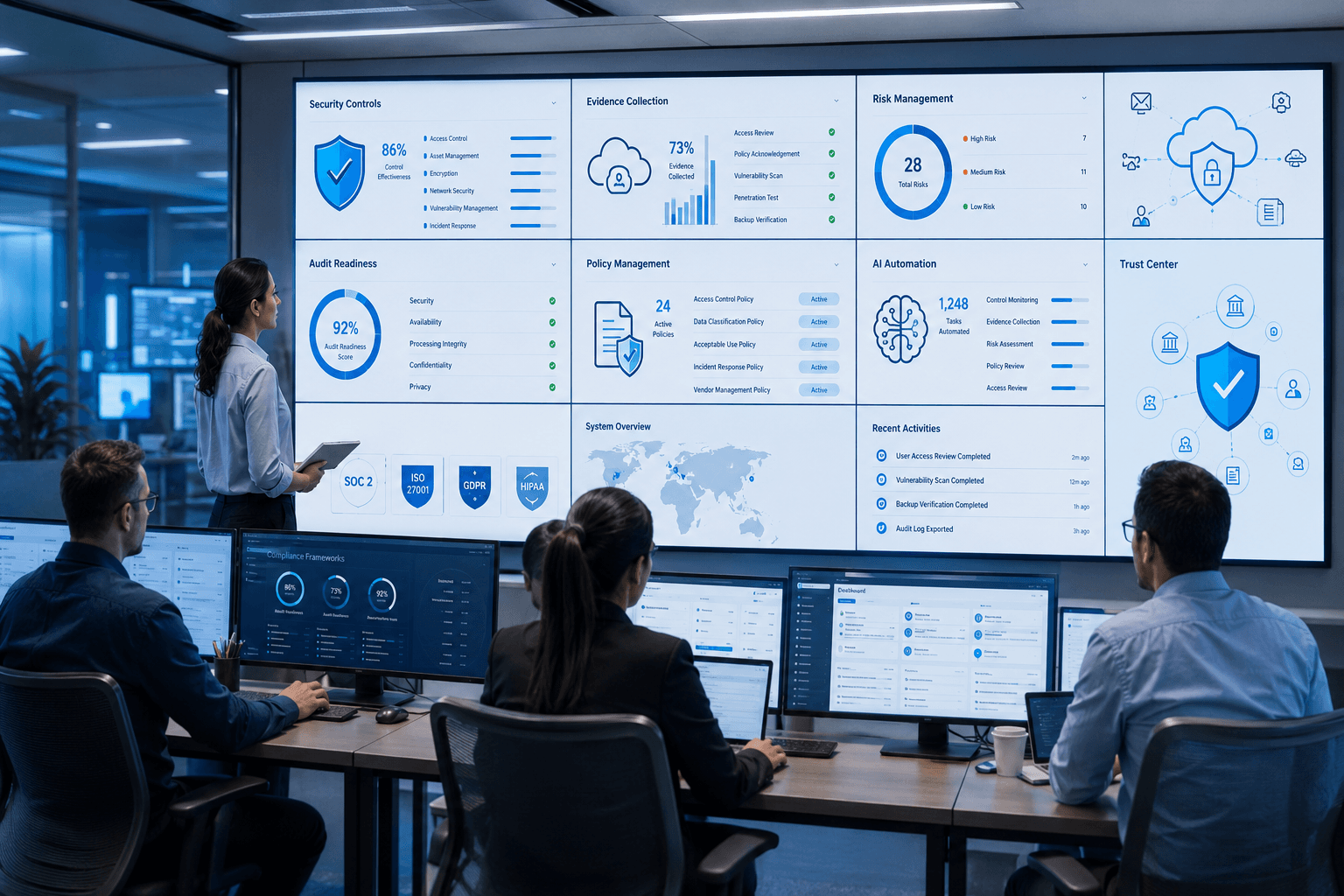
Modern compliance platforms automate much of the work involved in preparing for SOC 2.
Typical capabilities include:
- Gap assessments
- Policy management
- Risk registers
- Automated evidence collection
- Continuous monitoring
- Internal audits
- Trust Centers
- Auditor collaboration
Automation allows security teams to spend less time collecting screenshots and more time improving their security posture.
Typical SOC 2 Timeline
Although timelines vary, many organizations follow a similar path:
- Readiness assessment
- Gap remediation
- Policy implementation
- Risk assessment
- Evidence collection
- Internal review
- Independent audit
- Report issuance
The total duration depends on organizational maturity and whether a Type I or Type II report is being pursued.
Preparing for Success
Successful SOC 2 projects usually begin long before the external audit.
Organizations should:
- Define compliance scope
- Identify systems in scope
- Assign ownership
- Document policies
- Build a risk register
- Collect evidence continuously
- Perform internal reviews
- Address gaps before the audit
This preparation significantly reduces audit delays and last-minute stress.
Final Thoughts
SOC 2 is more than a customer requirement—it is an investment in stronger governance, better operational discipline, and long-term trust.
Organizations that approach compliance as a continuous process rather than a one-time project are better positioned to scale, win enterprise customers, and respond confidently to evolving security expectations.
Whether you’re pursuing your first SOC 2 report or expanding your broader compliance program, investing in the right processes and tools can make the journey more predictable and efficient.
Call to Action
Simplify Your SOC 2 Journey with Qireon
Qireon helps organizations prepare for SOC 2 with AI-powered gap assessments, policy management, automated evidence collection, risk management, internal audits, and continuous compliance—all within a single platform.
Start your free trial or book a personalized demo to see how Qireon can accelerate your compliance journey.